1. What RTP actually measures
Return to Player is the proportion of all money staked on a game that the game returns as winnings, calculated across the game's entire theoretical lifetime — typically millions or tens of millions of simulated spins. A 96% RTP means that across that enormous sample, ₱96 is returned for every ₱100 staked.
The critical word is theoretical. RTP is a property of the game's mathematical model, verified by independent testing laboratories before certification. It is not a promise, a rate, or a description of any individual session. Over 300 spins — a realistic evening — actual return can land anywhere from 0% to several thousand per cent. The published figure tells you nothing useful about that range.
The honest framing: RTP tells you the price of the entertainment over the long run. Volatility tells you what the short run will feel like. Almost every player checks the first and ignores the second, which is exactly backwards for a single evening's play.
2. House edge in pesos
House edge is simply 100% minus RTP. At 96% RTP, the edge is 4%. Applied to turnover — not to your deposit — that produces the following:
| Total turnover | 96% RTP (4% edge) | 94% RTP (6% edge) | 92% RTP (8% edge) |
|---|---|---|---|
| ₱10,000 | ₱400 | ₱600 | ₱800 |
| ₱50,000 | ₱2,000 | ₱3,000 | ₱4,000 |
| ₱70,000 | ₱2,800 | ₱4,200 | ₱5,600 |
| ₱200,000 | ₱8,000 | ₱12,000 | ₱16,000 |
Two observations worth sitting with. First, turnover is not the same as deposit — a ₱1,000 deposit cycled repeatedly can easily generate ₱30,000 of turnover in an evening. Second, the difference between a 96% and a 92% title is not a rounding error; it is double the expected cost of the same play. Some games ship in multiple RTP configurations and the operator selects which to run, which is precisely why you check the in-game info panel rather than a third-party database.
That ₱70,000 row is not arbitrary — it is the exact turnover generated by clearing a typical 35× welcome bonus, as worked through in the bonus guide.
3. Volatility: the number that actually matters
Volatility (or variance) describes the shape of the distribution, not its average. Two games can both return 96% while delivering completely different experiences.
| Volatility | Typical hit frequency | Feature gap | What a session feels like |
|---|---|---|---|
| Low | 30–40% of spins | 60–100 spins | Frequent small returns, slow bankroll drift |
| Medium | 22–30% | 100–160 spins | Mixed; occasional meaningful wins |
| High | 18–25% | 150–300 spins | Long dry runs punctuated by rare large hits |
| Very high | 15–22% | 250–500+ spins | Brutal stretches; most sessions end at zero |
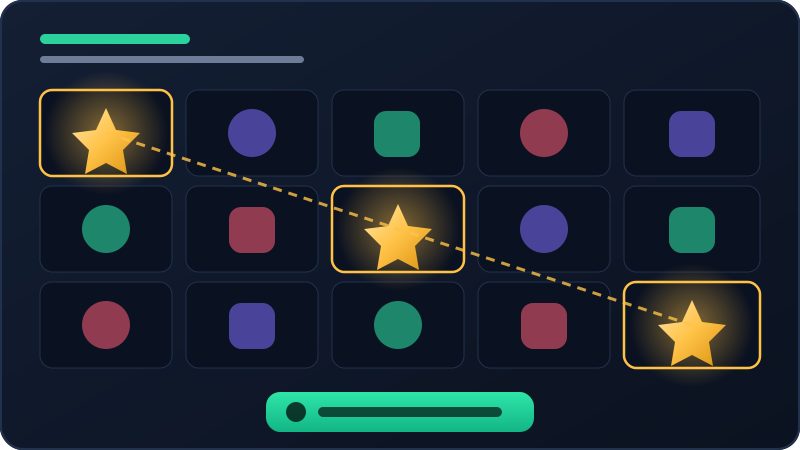
Scatter-driven titles cluster in the high and very-high bands, because the free-spins feature carries most of the game's return. That means the base game is deliberately impoverished — it has to be, for the maths to balance. This is why a high-volatility scatter slot can feel "cold" for two hundred spins and then pay several hundred times stake in ninety seconds. Both phases are the same game working exactly as designed. We cover the trigger mechanics in scatter games explained.
4. Hit frequency vs payout size
Hit frequency is the share of spins returning anything at all. It is routinely misread, because a "hit" includes returns smaller than your stake. A 25% hit frequency sounds reassuring until you notice that many of those hits pay ₱4 on a ₱20 spin — a loss dressed up with a winning sound effect.
This is deliberate design, sometimes called a loss disguised as a win. The audio and animation for a sub-stake return are frequently identical to those for a genuine win. Your brain registers a reward; your balance registers a loss. Knowing this does not stop it working, but it does let you evaluate a session by the balance rather than the feeling.
Practical habit: judge a session by the number in the balance field, never by how it felt. Write down your starting balance. Compare at the end. Feelings during play are engineered by people who are very good at their jobs.
5. The stake-sizing rule
Here is the arithmetic that prevents most avoidable losses. Your stake should be small enough that your bankroll spans the game's feature gap — otherwise you are paying for a feature you will never see.
Divide your session budget by the feature gap.
High volatility, 200-spin typical gap, ₱2,000 budget → ₱2,000 ÷ 200 = ₱10 per spin.
Very high volatility, 350-spin gap, ₱2,000 budget → ₱5 per spin.
Medium volatility, 130-spin gap, ₱2,000 budget → ₱15 per spin.
If the resulting stake feels too small to be entertaining, the honest conclusion is that your budget does not fit that game — and the correct response is to choose a lower-volatility title, not to raise the stake. Raising the stake does not improve your odds; it shortens the time before you have none left. The same logic appears as the 150-spin rule in our cornerstone guide.
6. Fallacies this maths kills
- "It's due." Spins are independent. The RNG has no counter and no conscience. Technical standards for RNG certification are published by regulators including the UK Gambling Commission, and independence between outcomes is a core requirement of every one of them.
- "96% means I get ₱96 back per ₱100." It means that across the game's theoretical lifetime, not your evening. Your evening is a sample of a few hundred draws from a very skewed distribution.
- "Higher stakes improve my odds." They scale outcomes, both directions, and shorten survival time.
- "This game pays better at night." There is no time variable in the model. None.
- "I can win it back." The most expensive sentence in gambling, and the clearest signal to stop. Support is free and confidential through services listed on our responsible gaming page and via GamCare.
This article was drafted with AI assistance and reviewed, edited and fact-checked by Grant Storm before publication. Volatility bands and hit frequencies are industry-typical ranges for illustration, not measurements of any specific title. Check each game's own info panel. Full details in our AI content disclaimer.
Size the stake before you spin, not after
Budget divided by feature gap. It takes five seconds and it is the difference between playing a slot and buying a lottery ticket at slot prices.
21+ only · Play responsibly · Gambling involves risk of financial loss